Tuesday, 28 October 2014


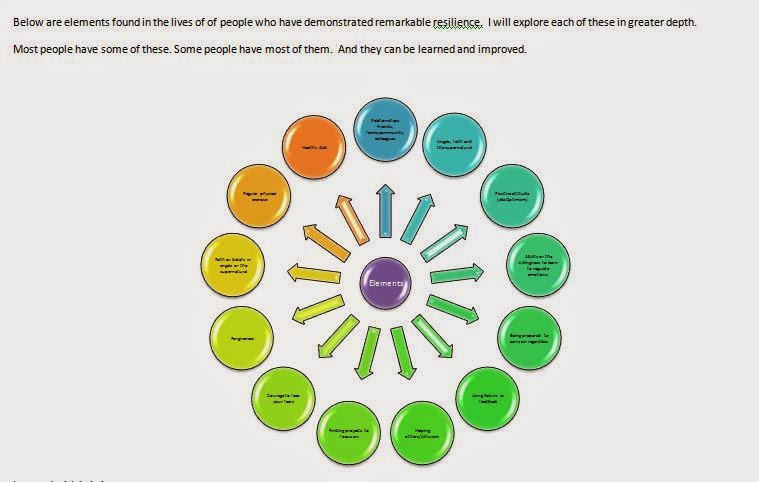
Elements 


      • Relationships. Friends, family,community, colleagues.
      • Angels, faith and the supernatural
      • Positive attitude (aka Optimism) 
      • Ability or the willingness to learn to regulate emotions
      • Being prepared to carry on regardless
      • Using Failure as feedback
      • Helping others/Altruism
      • Finding projects to focus on
      • Courage to face your fears
      • Forgiveness
      • Faith or beliefs in angels or the supernatural
      • Regular physical exercise
      • Healthy diet


Saturday, 30 August 2014

Resilience and Love


There are numerous well evidenced ways to understand this in literature about mental health and child development:

We learn to care for ourselves from the example of those who care for us when we are little.

Aka, if we experience love as children, we learn to love ourselves and others.


And if we don't then we need to learn  as adults.


Beyond trauma - the paradox of self care


The ability and motivation to care for ourselves is a paradox

Everybody who has it can take it for granted, and might feel ashamed if they demonstrate a failure to care for themselves.  However many people struggle to meet even their most basic needs, and some people experience guilt and shame when they look after themselves.

Sometimes this can be linked back to trauma, but it can also often be linked back to childhood.  It is now almost universally accepted that children who are neglected or abused grow in to adults with emotional/behavioural problems.

Those neglectful or abusive experiences can be understood as trauma, which enables us to bring a modern scientific understanding to the process of recovery.


We can also understand the impact of being raised in an environment where neglectful and abusive experiences occur and recur as influencing all the other functions of childhood, developing a personality, learning, acquiring skills.  In this understanding the emotional and physical environment of childhood teaches us our worth (limited) our role (to care for others or at least to prioritise their needs) and what we can expect from life (pain).


If you are feeling miserable, uncomfortable, unwell, then the instant comfort of junk food may appeal more than making the effort to cook a proper meal. The same would apply to drugs (including alcohol, nicotine and caffeine).  If you feel good, you will find it easier to avoid behaviors which make you feel better straight away but have no long term benefit. 

Self Care


Monday, 25 August 2014

Resistence to recovery


Given that the potential for resilience is present in most people, who is depressed? why do some people choose to end their lives rather than carry on and reap the fabulous benefits of overcoming hideous events?

 The road to recovery is littered with platitudes.  For example:

"You can never truly love another person unless you have learned to love yourself."


There are two reasons why some people struggle to develop resilience

Or: There are two necessary preconditions for resilience to develop in response to trauma and hardship.

1. We must be willing to care for ourselves.  This is a paradox because while most people will take this simple aspect of life for granted, a few of us will struggle to carry out the most basic acts of self care, probably because we have had difficult early lives.  It will not come naturally, will have to be learned; and will probably feel uncomfortable at first.

2.  We must be open to help.  This doesn't mean that we are compelled to adopt every piece of advice we are ever given, it means that we are open minded and flexible enough to be able to look at things another way, to hear another point of view, to keep trying different solutions to intractable problems.

One of these items can carry you to the other, for example if you are committed to caring for yourself, you will seek help when you need it.  Equally, if you are open to support and care from others, and receive good quality support, sooner or later someone will point out that you seem to find it difficult to act in your own best interests.